One of the hardest parts about nerve-related injuries is not knowing if things will calm down enough that the sensations will stop. You wonder if you will be stuck like this forever. Since I managed to make it through that dark and uncertain tunnel (again), I want to share what I did in case it helps someone else looking for answers and ways out.
As of yesterday, I have completed 6 mountain bike rides with no pain, and I am back in the saddle for short-medium mtb rides (up to 2.5-3 hours, or around 15-20 miles) and short road rides, like commuting to work. Riding still sometimes feels like a gamble: will I feel okay today? Did I do too much yesterday to ride today? Am I going to cause a set-back? Is that the beginning of pain I am feeling or just a “normal” sensation of riding? I listen so carefully to my body while at the same time trying to relax and enjoy every inch of trail, every corner, and the bliss of rolling on bike suspension. When I finish my ride back at the car, my gratitude levels are off the chart and the ride was “a success” as long as I am not in pain, even if my skills and fitness feel rusty.
I stopped riding in the winter due to saddle pain from trying a chamois on a 90-minute training ride that really was not a good fit for my body. It would not have lasted that long except that my brain didn’t turn the pain switch off and neuropathic pain stuck around for far longer than it should have, keeping me off the bike and looking for solutions for multiple expensive and emotional months.
Before I get carried away writing about anything else, here are some of the things that got me back onto my bike:
Aggressively and repeatedly seeking treatment. I immediately reached out to my gynecologist for an exam and to brainstorm solutions. We talked about western and eastern medicine, including pain medication, hormones, acupuncture, and TENS unit muscle stimulators for nerve pain relief. We made a plan according to the options I felt most comfortable with. Plans changed over time as I became increasingly open to more options, like taking low doses of Cymbalta. I am lucky to have a doctor that I really trust. I am terrified that she will one day move away or leave Kaiser.
Acupuncture. My doctor told me that studies have shown that regular acupuncture treatment in combination with Cymbalta or a similar SNRI drug has had very positive results. While I was reticent to take even a low-dose of an SNRI at first, I did not hesitate to get acupuncture treatment. There are two potential barriers here. First, it is SO hard to find a therapist that you like and trust, since weekly or biweekly visits may be necessary to see results. My first acupuncturist did not work for me, but I kept shopping. Second, you then need the money to pay that therapist out of pocket (in most cases). I saw two acupuncturists before I found my magician goddess, Dr. Maria Mitchell, located in Santa Cruz. She was recommended to me by a former student of hers who is a naturopath I found while cold calling around. I love that Dr. Mitchell inherited her late mother’s acupuncture practice, that she teaches acupuncture, and has an office that is a short walk to the beach. Not only am I receiving treatment there that has helped me heal, I feel like I am escaping real life, which is how I always feel in Santa Cruz.
Climbing and yoga. Between climbing, yoga, and cycling, if I can’t do one of these things, I can usually still do at least one or both of the others. Movement is medicine for my brain, and my brain needed meds! Climbing and yoga are both hard athletic activities that I could still do even when I could not tolerate a bike saddle. I didn’t just pick them up – I’ve been an avid climber for almost 25 years and found yoga in 2012 (thank you Emily) – but I found a lot of comfort in having other outlets for challenging myself and soothing myself through movement. Sport climbing got me outside and psyched to camp and adventure on weekends, and it is also a fairly social activity. I owe so much to my climbing partners, who I adore. If you’re a cyclist, you will appreciate that climbing is a complementary discipline that works your upper body, balance, core, and bravery muscles times one million.
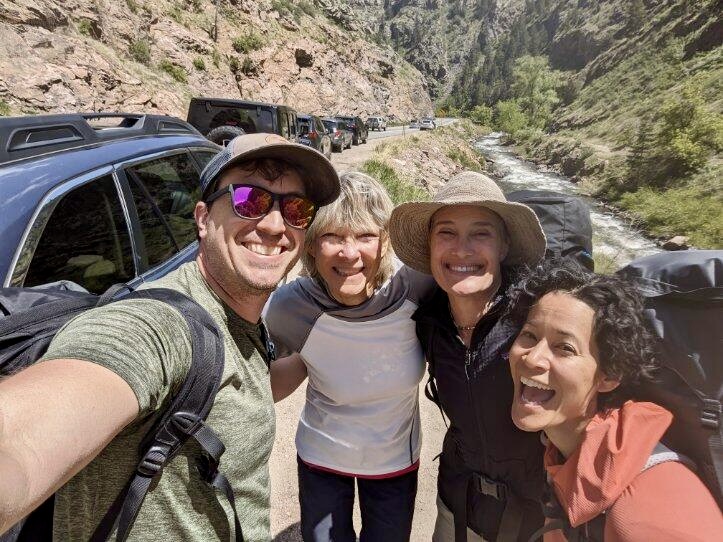
Trusting my support network. Find your people that you can ugly cry on. Who will ask how you really are doing, who you can trust to tell how you really feel. Who will pick up when you call. Who will give you props for being selfish, taking it easy, and turning inward into hardcore self-care mode. Enforce strong boundaries about giving time and energy to anyone else.
Staying busy. Being a bike person requires time. I had been riding my bike for 10-14 hours/week, not counting time spent in the garage doing minor bike maintenance, before my break. When I stopped, I suddenly had lots of unscheduled time on my hands. I hung out with Michael, wrote more and worked more, climbed more, went on climbing trips, did yoga routines using Glo.com (Jason Crandell is my favorite teacher), spent time in the garden, went to the ballet, went to the aquarium, visited my mom, got a tattoo (with my mom!), and made plans with friends. It helped to have places to turn my attention and think about what I can do rather than what I can’t.
While I am getting back into riding, I’m being careful to take things slowly, make adjustments, and try not to cause a setback simply due to fomo or wanting to be my “old” self. I made a bike fitting appointment and can’t wait to see Lorri Lee Lown (aka Savvy Bike) for re-fitting my bikes and talking saddle solutions. (I’ve been riding Terry Falcon X‘s on all of my bikes for years. I recently replaced my oldest saddle, which was on my commuter, with a Corta, and it’s a little better in some ways but I’m not sold yet.) I’m focusing on my present self, with care because I am still healing, rather than leaping ahead to where I want to be. For example, there was a local race I wanted to do yesterday. It was only 20 miles of XC and 3k climbing, but I hadn’t completed a 20 mile ride yet, which previously would have been a no-brainer. (If something goes wrong on course, it can wind up being a longer day in the saddle than intended.) I went so far as to do a practice 15 mile ride and order Tailwind and Gu’s last week, but ultimately called it off and chose to do a trial 20 mile ride in Santa Cruz with my hub instead. We had a great day, my body felt good (if a bit out of shape), and I even sent a rooty feature that I regularly chicken out of and ride around or walk. We celebrated with dinner out at Venus, where we hadn’t been since our rehearsal dinner in 2022.
On a very positive note, I’ve noticed more articles and media addressing the formerly taboo subject of women cyclists’ saddle pain and solutions to it. For example, Bicycling magazine published a game-changer article “Cycling’s Silent Epidemic” (3 May 2024) with a subtitle that spoke to me and many others whether it is or is not our exact issue: “Too many women stop riding their bikes because of labial swelling and pain. Here’s why it happens, what they can do about it, and how to prevent it in the first place.” In May, I was really struggling, but I sure was happy to know that I am not alone! There are Other Women Out There Somewhere, Dealing, who also had to stop riding for a time because of saddle pain. And check out that word “labial” in the subtitle! Even better, there is R&D happening to study and create more solutions for the very complex interface between a woman’s saddle, chamois, lube, and body. As someone said (I wish I could remember who), a person should not have to ride a recumbent bike just because she has a vagina. When it comes to women’s equality in sport, there is a parallel in healthcare: being able to speak about our body parts and needs without shame is a prerequisite to getting what we need and deserve.
(I aspire to make a bibliography of articles I can find on saddle pain in women’s cycling. I haven’t started yet, but who doesn’t love procrastination projects … )
 Mountain Lady Views
Leave a comment