Content warning: discussion of body image, weight, and disordered eating relating to sport.
If you’ve hung out with me on the trails or climbed with me in the past couple years, at some point I’ve probably talked your ear off about eating. My eating habits have changed dramatically for the better in the past 7 years. By better, I mean that I generally eat more than I used to, I eat more grains and carbs, and I continue to eat a lot of protein and vegetables. I don’t worry about eating too much: I make sure I always eat enough to feel great on my bike. Also, I eat whatever I want to that my dietary restrictions allow. (I am allergic to gluten and also to acidic foods.)
Why wasn’t I eating much in the past? Mainly, because of climbing. I wanted to climb higher grades, and I was trying to work my way up to sending 5.13a sport routes. I got really close and sent a couple 12d’s, but I still have yet to send a 13. (I’ve mostly let that goal go, probably for the better.) As Caroline Treadway shows in her important documentary “Light”, climbing culture, and especially but not exclusively women’s climbing culture, rewards those with the least body fat. This dangerous logic goes like this: the less you weigh, the less body weight you have to carry up a route, the harder you can climb. It’s dangerous logic because it works: when I lost weight, footholds that once looked useless became reasonable and “bomber,” tiny crimps felt like jugs, and my newfound “strength” helped me manage my fear on routes with longer runouts between bolts. It feels like you’ve unlocked the secret to crushing like all the strong weekend warriors at Rifle who project 5.13, but all the while under the hood your body and brain are breaking down.

What did my eating look like on a daily basis when no one was watching? I ate 2 eggs and a crepe for breakfast with black coffee or tea. For lunch, I had 2 Lara bars and maybe an apple. I drank fizzy water. Sometimes I had a couple dark chocolate squares for a treat during work. For dinner, I had a salad with chicken sausage, fat free dressing, and cheese crumbles. No dessert. If I was close to sending a route, I might skip dinner every other day and just drink chocolate milk instead of eating. I would still relax with 1-1.5 alcoholic beverages every night. Sure, I was eating, but not very much.
To make matters worse, when you starve yourself, you get skinnier and appear to have bigger muscles, your veins pop, and lots of people will tell you that you look *fantastic*. I was proud of my six-pack and arm muscles that seemed to come out of nowhere (note: they were always there). I’m pretty sure this is how I got asked out in a yoga class in Boulder by a guy who didn’t even know my name. (I called him on it once we got to the bar.) Younger and naive me was flattered at the time, and it flamed out faster than I could fall out of Warrior III.
To put this all in context for my own body, I am 5’6″ inches with a small-medium female athletic build that is naturally not curvy, and when I get strong I don’t easily build bulky muscle. When I played Division I tennis for Davidson College as an undergrad, I weighed somewhere around 130-135 lbs, never knew my precise weight, and didn’t care one lick about what my abs looked like. I ate whatever I needed to survive long practices and hard matches in the North Carolina heat. My quads were epic. In contrast, when I was climbing the highest grades for me, I knew my precise weight and aimed for 115 lbs, or 118 llbs on the scale accounting for 3 pounds of clothing in the summer, more like 5 clothing pounds in the winter. (This either sounds bonkers to you, or you can fully relate to this kind of perverse scale math.) When I look at photos of myself back then, my cheeks look sunken and I look so, so skinny. This perspective on myself took years to gain.
What changed things for me? First, I had two trusted girlfriends, both climbers, say to me: you look too skinny. I knew they were right, and I worked with a doctor to make a healthy change, but it did not immediately stick. What worked best, sadly, was moving and stepping temporarily away from climbing and replacing it with trail running and mountain biking. When I left New England for a job in Santa Clara, CA in 2017, I left behind Rumney (NH) and Rifle (CO), the only places I really wanted to sport climb, and the climbing families I had there. I had a very hard time in the Bay Area finding a home crag for sport climbing that inspired me and, more importantly, I struggled during my search for new climbing friends. Devastated and missing my NH and CO friends in 2017-18, I turned to trail running and mountain biking to fill in the hole in my heart.
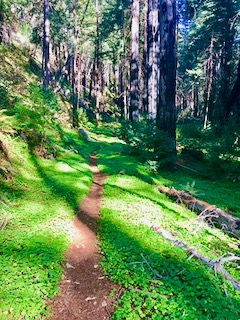

I had been running on roads since I was 13, when my parents first let me do 3-5 mile loops from our house in Andover, MA. However, I rarely left the pavement and had never in my life brought water or food with me on a run. Trail running was new to me and from my earliest experiences it seemed to require more of everything: navigation, gear, time, and also water and fuel. I bought a book by Sarah Lavender Smith called The Trail Runner’s Companion (2017) and discovered an entire chapter devoted to how to eat and drink, including eating and drinking while you run. This is the exact opposite of my old climber’s mentality of eating as little as I could get away with to maximize performance: the trail endurance game is all about always eating enough as an integral part of playing outside in the mountains. I bought a running pack and carried Lara Bars and water with me on every run, and eventually I started bringing UnTapped maple syrup and Gu gels for when I wanted extra “jet fuel.”
Trail running taught me to stop linking eating less and low weight with high performance.
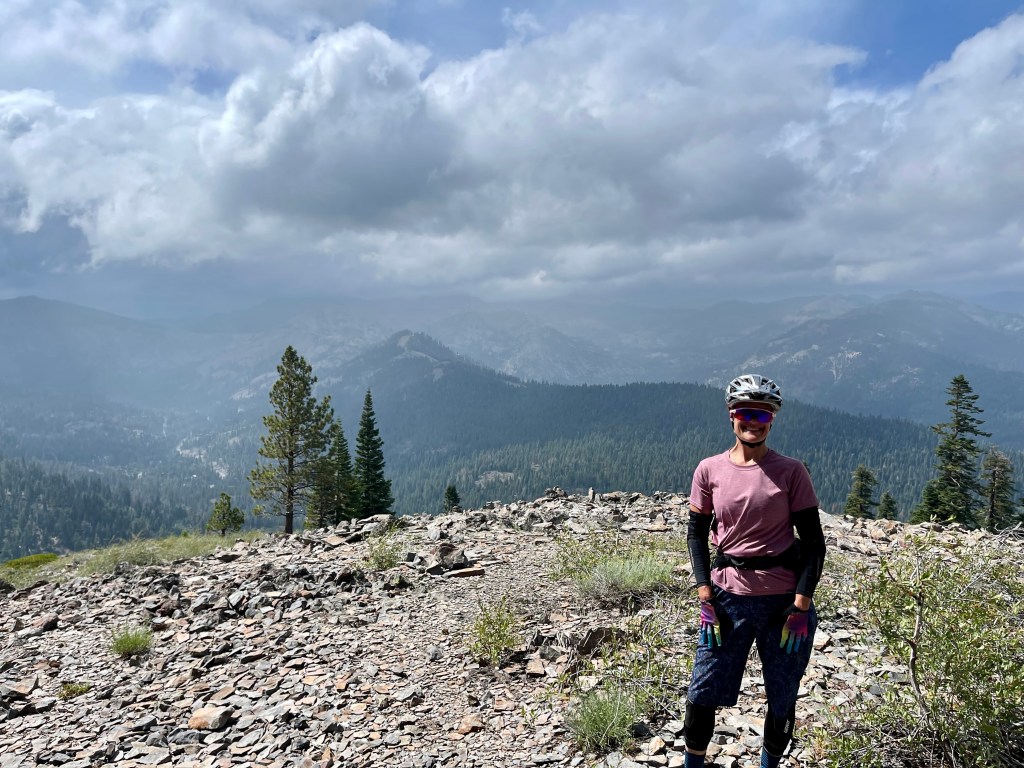
In addition to eating being part of running, my personal experience of trail running and its culture, as a late 30s and early 40s athlete, didn’t involve hanging out in large groups of people in sports bras and shorts staring at each other’s bodies between burns on a route. That was a climbing-specific scene (I know it exists in other sports as well). It probably happens elsewhere in trail running, but I was fortunate to avoid it. I stopped caring about the fact that I lost my six-pack because I had a new, really hard sport to learn that required calories to move well, and if I made mistakes I literally fell on my face in the dirt or, worse, on my ass in a bed of poison oak. I was a beginner again, I was having a lot of success learning how to run and race, and I loved it. When I blew out my right hip running in the High Sierras during the pandemic, I had already learned how to mountain bike and switched my trail time from running to biking. Fueling on a bike is just as important as fueling while you run, so I used what I had learned about eating for running and adapted it to riding.
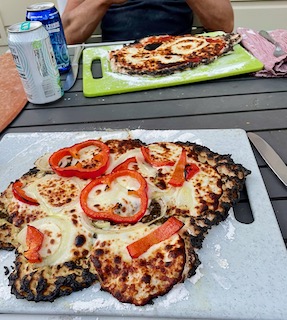
What does eating look like on a daily basis these days? It’s not as formulaic, for one thing. Part of my disordered climber eating was that I stuck to a strict daily plan (see paragraph 3). Now, I eat what I want. For breakfast, this is usually a banana and a breakfast burrito, or banana and rice cakes with peanut butter and jelly, or gluten free cereal in milk. I would really like to buy a blender to start adding smoothies to the menu. If I have an early gym session planned from 6-8am, I’ll eat a Lara bar or a banana beforehand and will have breakfast right afterward. For lunch, I usually make a turkey and cheese sandwich in a gluten free wrap with Ranch dressing for extra flavor (I love Trader Joe’s quinoa wraps). I am obsessed with Hidden Valley Ranch and it can go on nearly everything. I’ll eat chips, crackers, a chocolate chip Lara bar, an apple, or even m&m’s for a snack before I head home from work. On campus, if I’m fading and I have a huge teaching day, I’ll have a Coke or a chai latte as a pick-me-up. After I bike home from work, I snack on chips and hummus while we cook dinner. We cook every night and each night has a theme, a fun ritual we started during the pandemic. Monday is pizza night, Tuesday is “taco Tuesday” (obviously), Wednesday we usually have fish and a veggie, Thursday is often stir-fry or pasta, Friday we cook burgers on the grill with homemade fries, and the weekend is ad-lib depending on our outdoor plans. Having a spouse who is also an athlete, who likes to cook, and who eats a lot and is a healthy eater is awesome. I am very lucky in this regard. We rarely eat out.
Slipping back into my old obsession with maintaining a very lean frame would not be hard, especially since I’m still climbing 3 days a week and I am projecting harder sport routes again while I have more muscle and fat – which, I keep reminding myself, are all good things. Here are a few ideas that help me stay on my personal healthier path:
- Performance as positive reinforcement. Lately, because I have been eating like a champ and also riding a bunch, I’ve been feeling pretty beastly both on the bike and in my climbing! Why would I change my diet if I’m eating what I want and performing? For example, last weekend we rode 108 miles of gravel with 11k feet of climbing! It was my biggest weekend ever on a bike, and besides the 100 degree temps in Paso Robles that made me want to move into an ice cream shop, I felt great. I did not cramp, and I could have ridden even farther. This is positive reinforcement that keeps my brain from caring too much about what the stomach skin between my sports bra and my shorts band looks like. However, if I need to take time off to heal an injury (hello 40s), I can’t rely on performance gains alone to sustain healthy eating habits. Instead, I may turn to:
- Beth Rodden’s Instagram. Beth, I have admired you as a climber since I was a brand-new gumby in 2000 learning what a jug is in the squished old upstairs Boulder Rock Club bouldering cave. The work you are doing on social media to normalize healthy eating, body weight, and body image has been a lifeline for me and for many of my climbing partners who were part of the early 2000s and 2010s Boulder climbing scene. We all tracked our body weight. Now, we are all older and working on a healthier relationship with food and our bodies in sports (and we all still climb). You’re showing us how to work through feeling good about our collective bad-@ss selves in a sports bra and shorts, with bellies, on social and IRL. Thank you, and I hope I get to thank you in person one day!
- I am a devoted listener to the SWAP podcast, hosted by trail running coaches David and Megan Roche, and in recent episodes I have heard them repeat: “eat enough, always; too much, sometimes; too little, never.” Here’s an article by David that describes this ethos in more detail. The general idea is that food can be fun, and as athletes our relationship to food doesn’t have to be a binary of good/bad, eat-this/avoid-that. Again, as athletes, as long as we stay away from under-fueling, which is scientifically proven to harm us, we’re somewhere in the green. In moderation, eat whatever the hell you want and “leave room for cream” (as the Roches say)! I hope they will keep sprinkling this message into their podcasts for the duration of that project. For many athletes like me, and I think there are a lot of us, having this new mantra helps drown out the old refrain in our brains that says we would perform better and look hotter if we weighed less. That’s bullshit. (Keep reminding me, and I’ll keep reminding you!)
- “Food doping.” Another fun phrase I learned from SWAP, “food doping” is the idea that we can now use food/fueling to achieve the same or similar performance gains that previously have been achieved with the use of horribly illegal substances (aka, dope doping). The idea of food doping is working really well on my brain during rides. It’s scientifically very complex, and I defer to real experts for details, but the way I apply this idea to my own riding is simple: I carry with me and eat about twice as many gels as I used to on my rides, I have felt better with a higher intake, my legs haven’t cramped on rides where I expected them to, and I have also had no stomach issues with high quantities of gels. See SWAP episode 167 for a deeper dive, but know that there have been several episodes related to “food doping” and the benefits of taking in more calories on the trail. They’re not wrong! Slurp those calories!
- Remembering that I am a wise, strong, and resilient woman who intends to adventure and do hard things in the mountains for as long as my body lets me. To play the long game, as they say, I have to take care of my body. Sharing my story and what I’ve learned helps me make good choices at the same time as it, I hope, helps others, especially younger athletes who can be susceptible to peer pressure and media influences.


 Mountain Lady Views
Leave a comment